Ready to check your car's history report?
Where's My VIN?

What is a VIN?
A Vehicle Identification Number (VIN) is a unique 17-character code that serves as your car's fingerprint. It contains letters and numbers that identify:
- Manufacturer and country of origin
- Vehicle make, model, and year
- Engine size and type
- Assembly plant location
- Production sequence number
Common VIN Locations
You can find your VIN in several places on your vehicle:
- Driver's Side Dashboard: Most visible through the windshield from outside
- Driver's Door Frame: Look for a sticker on the door pillar when door is open
- Engine Bay: Check the firewall or front of the engine
- Registration Label: Usually under the hood or on driver's door frame
Alternative VIN Sources
- Vehicle Documents:
- Registration certificate
- Insurance policy/card
- Service records
- Purchase documentation
Tip: VINs use capital letters and numbers only. The letters I, O, and Q are never used to avoid confusion with numbers 1 and 0.
Where's My Chassis Number?
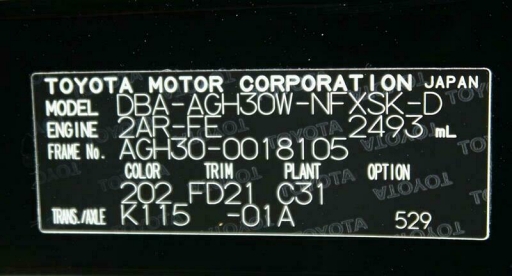
Japanese carmakers do not use a Vehicle Identification Number (VIN) as is common in the United States and elsewhere. Instead, Japan uses a Chassis (Frame) Number — nine to twelve alphanumeric characters identifying model and serial number.
Where to find the Chassis Number:
- Under the front passenger seat
- On the firewall in the engine bay
- Inside the driver's side door frame
- On the vehicle registration certificate
Example Breakdown:
Chassis Number: AGH30W-0018105
- "AGH" - Series code
- "30" - Model code (Alphard)
- "W" - Body type (Wagon/Van)
- "0018105" - Serial number
Vehicle make is not identified but slight number variations can identify the carmaker:
- Toyota usually uses seven digits for serial numbers
- Nissan uses six digits
Model Code:
Because a Chassis Number contains less information than a VIN, Japanese vehicles also use a Model Code.
Example: AGH30W-NFXSK
- "AGH30W" - Model identifier (Alphard Wagon)
- "NFXSK" - Vehicle features code